You can see all of the Twin Cities essays, which were wonderful, here:
http://www.youtube.com/playlist?list=PL5oPQWgVdsDkaevsjrlsSr4g07SJDyWL6
A Riot in Bloom

When I was a little girl, I misheard “a riotous bloom” as “a riot in bloom.”
Today, on my commute to work, the peonies were the very definition of a rebellious riot in bloom: tossing their gorgeous, heavy, fragrant frowsy heads, careless of how their skirts fell or whose eye they arrested: loud and crowded and dangerous on the hillside.
I could almost hear their throaty, wispy voices crying: “We’re here! Mid-June! Get used to it!”
I could almost see the placards held in their glossy, leafy fingers that they’d thrown together the night before in a drunken fit of spontaneity, with blowsy strokes of their petals in vivid pollen: “Beauty is fleeting, but give it a chance!”
Dad
I try hard every year to make Father’s Day about the father of my children, not my own Dearly Departed.
I have had middling success over the years, especially the years right after his death.
My dad didn’t even like Father’s Day; he saw it as a Hallmark Holiday. I would call him and wish him a Happy Corporate Takeover of Our Culture Day or something, or say hello I am calling you for absolutely no reason whatsoever. But he was always pleased I’d called.
So I try to focus on Jan, who is an excellent father and to whom I am deeply grateful.
But the world keeps trying to make me think of Joe instead. Last night, on my way to a dance performance, I was stupidly listening to a Prairie Home Companion on the highway. Yes, yes, I have only myself to blame.
Keillor’s banal, insipid, dull characterization of dads filled me with venomous rage. He clearly had no idea what a truly interesting, engaged, weird and wonderful father could be: either from his experience as a son, or — worse — his experience as a father.
I finally did myself a favor as I was beginning to tear up and turned it off.
Calmed myself by singing a nice little Dixie Chicks ditty about killing someone.
Just as I approached the school where I was performing, what church do I pass?
Saint Joseph the Worker Church.
THANK YOU SO MUCH UNIVERSE HOW INCREDIBLY FUCKING HELPFUL
LATER: And then today we went and saw The Croods, which no one had warned me about. Again. Thank you, universe. That was awesome. Message received: this Father’s Day is all about Joe.
Jesus Loves Me
I have had random strangers scream lots of things out of their car windows at me over the years: “Get a car!” “Suck my dick!” and the tried-and-true: “LESBIANS!”
Today was a first: I was standing outside of the Episcopal Cathedral in Faribault, chatting with a coworker after our presentations, and a woman shrieked scornfully out of her window: “PRAISE THE LORD!”
After I finished laughing so hard I nearly peed, I decided it was vindication. I have been a little worried I am not dressing the part enough for my job. Apparently, I am dead-on.
Come see Listen to Your Mother: Twin Cities!
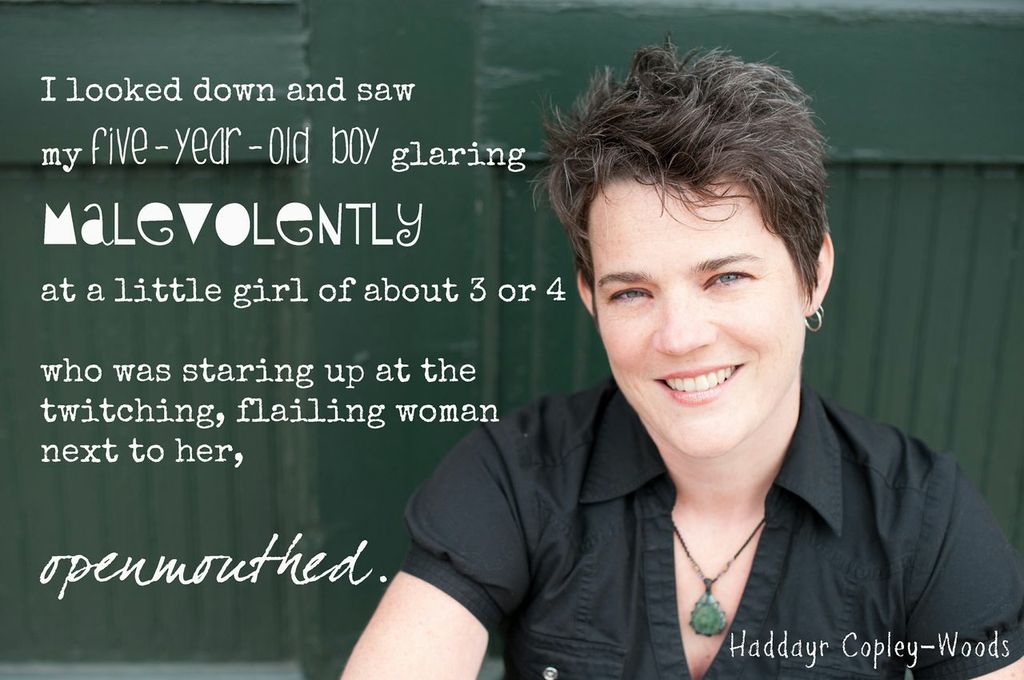 This Thursday, May 9 at 7 pm, I’ll be joining a terrific cast of women reading essays on mothering our kids and, in some cases, our own mothers — in Listen to Your Mother: Twin Cities at the Riverview.
Advance tickets are $15; $18 at the door.
This was eerily similar to my Meyers-Briggs results
I Am A: Chaotic Good Human Rogue (6th Level)
Ability Scores:
Strength-14
Dexterity-12
Constitution-14
Intelligence-14
Wisdom-17
Charisma-15
Alignment:
Chaotic Good A chaotic good character acts as his conscience directs him with little regard for what others expect of him. He makes his own way, but he’s kind and benevolent. He believes in goodness and right but has little use for laws and regulations. He hates it when people try to intimidate others and tell them what to do. He follows his own moral compass, which, although good, may not agree with that of society. Chaotic good is the best alignment you can be because it combines a good heart with a free spirit. However, chaotic good can be a dangerous alignment when it disrupts the order of society and punishes those who do well for themselves.
Race:
Humans are the most adaptable of the common races. Short generations and a penchant for migration and conquest have made them physically diverse as well. Humans are often unorthodox in their dress, sporting unusual hairstyles, fanciful clothes, tattoos, and the like.
Class:
Rogues have little in common with each other. While some – maybe even the majority – are stealthy thieves, many serve as scouts, spies, investigators, diplomats, and simple thugs. Rogues are versatile, adaptable, and skilled at getting what others don’t want them to get. While not equal to a fighter in combat, a rogue knows how to hit where it hurts, and a sneak attack can dish out a lot of damage. Rogues also seem to have a sixth sense when it comes to avoiding danger. Experienced rogues develop nearly magical powers and skills as they master the arts of stealth, evasion, and sneak attacks. In addition, while not capable of casting spells on their own, a rogue can sometimes ‘fake it’ well enough to cast spells from scrolls, activate wands, and use just about any other magic item.
Find out What Kind of Dungeons and Dragons Character Would You Be?, courtesy of Easydamus (e-mail)
On assuming you know things and being happy and biking
I posted this wonderful article on Facebook last night by The DIY Couturier: 21 Tips to Keep Your Shit Together When You’re Depressed.
It was a direct response to one of those interminable articles by happy people on how to be happy just like them (quick sum-up: it’s not luck, stunningly easy access to the upper middle class, or the blessing of well-balanced brain chemistry! Happy people are happy because they are doing things right, and if you just followed their blithely oblivious rules you’d be happy, too) titled The 21 Habits of Happy People, which I will not link to because after reading a few of them my blood began to boil AND I began to die from boredom, which is a uniquely unpleasant sensation I do not wish upon my readers. Also the stock photography was aggressively banal.
Besides the fact that these 21 alternate rules are extremely helpful and well-written and make me feel less alone in this world, I share this article because I want to talk about biking. Yes.
When people hear that I am a year-round bicyclist, I get, mainly, one of three reactions:
- You’re crazy! (Often followed by stammered reasons for the person’s failure to bicycle. I am not a bike nut AT you, my dear fellow on this planet; I couldn’t care less if you bike. I do not exist solely to make you feel bad about yourself.)
- You’re so brave! (Often followed by even more panicked reasons for the person’s failure to bicycle. If a cripple can do it, she must judge me for not doing it!)
- You must have something to prove. (This being Minnesota, this judgment is nearly always couched in alternate but crystal clear language.)
Oh! People are saying. I know you. I know you are crazy. I know you are brave. I know you have something to prove.
And none of these things are true.
I bike year-round because it is fun. I also bike year-round because I am depressed, anxious, and I have an autoimmune disorder. If I do not bike nearly every day, I get sick, I have a flareup, or I become a heinous bitch. I have real and rather personal reasons for bicycling every day, and if I don’t share them with every random person who asks me about the bicycle helmet in my office that’s my prerogative. Speaking out in a chosen time and place (such as this blog) to de-stigmatize mental illness is one thing, but telling someone deeply personal health information who just stopped by to borrow a stapler and wants to get defensive about my reflective vest hanging on the doorknob is another.
When I got my concussion on glare ice this winter (after writing a commentary on the joys of winter biking, ironically), someone actually said to me: “Well, I hope you learned your lesson.”
I’m sure many, many more people thought it.
The only way in which this comment makes any sense is if you are assuming, incorrectly, that you know why I bike.
Well, if you’re reading this, you now know why I ride. I ride for the OPPOSITE reasons of crazy. If I were to ‘learn a lesson’ from this concussion, it would be: do not do things that make you happy and healthy; you might get hurt! Do not fly gloriously over the frozen tundra. Do not take dance classes that make you look silly. Do not try for that job that might be a stretch. Do not write a book that digs into your deepness. Do not ever, ever fall in love.
So, no — I have not learned my lesson, and I hope I never will. Yesterday, even with a very bad head cold, I biked to work for the first time. It was glorious. Even just 25 minutes of bicycling made me start to feel myself for the first time since I fell in early February. Today, I biked again, in the rain. It is now snowing out. If the puddles have not iced over, I’m riding home again.
I bike because it makes me feel solid, sane, and whole. I am working my own 21 Tips in my own way.
Everyone you meet is fighting a hard battle, as the famous quote misattributed to Plato goes. Be kind.
You work your own tips, and I’ll work mine.
On the supposed “death with dignity” movement, and the value of a disabled life
Whenever assisted suicide comes up amongst my friends and family, they are very pro-assisted suicide. I get angry and quiet and don’t have the energy to explain explain explain, which is unusual for me, but this topic is so vast and exhausting and sometimes I think that no one with a disability is in any position to see the medical industrial complex from my point of view because they have never been treated the way I have in a doctor’s office.
This essay by Rachel Cohen-Rottenberg about Amanda Baggs and the pressure the medical establishment is putting on her to turn down life-saving procedures and just die already gets at the heart of why I object to this. Please read it:
“I think that many people feel that they would rather die than to be treated as though they are worthless. And so they put forward legislation that will give them a way out. But they don’t realize that we can fight the idea that it’s better to be dead than ill or disabled — that we can react to it with outrage, and that we can create communities of support so that none of us ends up with our worst fears realized.”
http://www.disabilityandrepresentation.com/2013/04/06/amanda-baggs-the-pressure-to-die/
No mention was made of his most potent weapon: making his enemy laugh so hard that she is utterly helpless to defend herself.
“And his meal has just unsuspectingly walked up to his front door. The Haddayr is larger and stronger, but no match for the more agile Bob. Even though Haddayrs are meat-eaters, more than twice Bobs’ size, and prey on Bobs, he is not going down without a fight. When he grabs on, there is almost no escape. She puts up a fearsome defense with her strong arms, but she is no match for this vicious creature. Turning the tables completely, he strikes. She is subdued and stunned from each one of his strikes. He strikes again and again until she is finally dead. Then, the Bob can feast on her flesh.”
Sing each verse as if it were the whole song.
I do not believe that God has a plan for me. I do not believe in fate. I do not believe that I am some kind of special creature the universe is trying to teach a lesson. I think if there is a god she cares about and nurtures my potential as much as she cares about and nurtures a gnat’s potential.
But I can choose to take lessons from the patterns around me.
I am currently in EMDR therapy for PTSD. I have been very frustrated after my concussion with the fact that I could not continue the EMDR until I recovered some. “The whole schedule is off,” I’ve scolded. “I was supposed to be fixed by June.”
So, now that I’m healed and can do some EMDR, we worked, instead of on a particular memory, on the idea that I don’t have to see delaying of therapy as a failure of some sort, or even as a setback. I don’t have to be so damn goal oriented, constantly frustrated that I am not all fixed. I can take some pleasure in getting to know myself better, in experiencing self-care, in investigating what makes me tick as much as I would take pleasure in revising an essay, short story, or novel.
I LOVE revising. There’s no reason why I can’t enjoy revising the story of my life and the story of who I am, just for the sake of revising.
Right after the session, I and my boys went to a seder at a friend’s house, and this passage from the haggadah struck me like a gong — I actually felt myself vibrate with it; felt my eyes fill with tears of recognition:
What does this mean, “Dayenu — it would have been enough”? Surely if God had brought us out of Egypt but not divided the Red Sea for us or sustained us in the desert, it would not have been enough. Dayenu means to celebrate each step toward freedom as if it were enough, then to start out on the next step. Dayenu means that if we reject each
step because it is not the whole liberation, we will never be able to achieve the whole liberation. Dayenu means to sing each verse as if it were the whole song — and then sing the next verse!
While I got my own personal message about my experience in therapy, my friend who read it also was in tears. For her, it was the struggle for gay civil rights.
I don’t think God was trying to send either of us a message; I just think some ideas are so universal that we can all find the messages we need to hear inside of them.
 Haddayr Copley-Woods
You must be logged in to post a comment.